
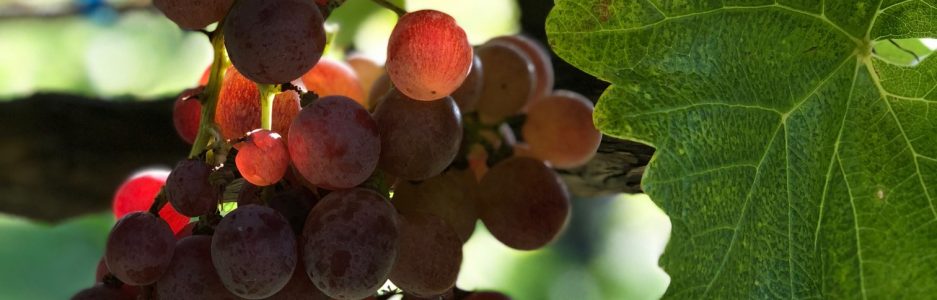
The Cornfields of Tomigahara Village framed by Mount Madurao (top) and Mount Kurohime (bottom)

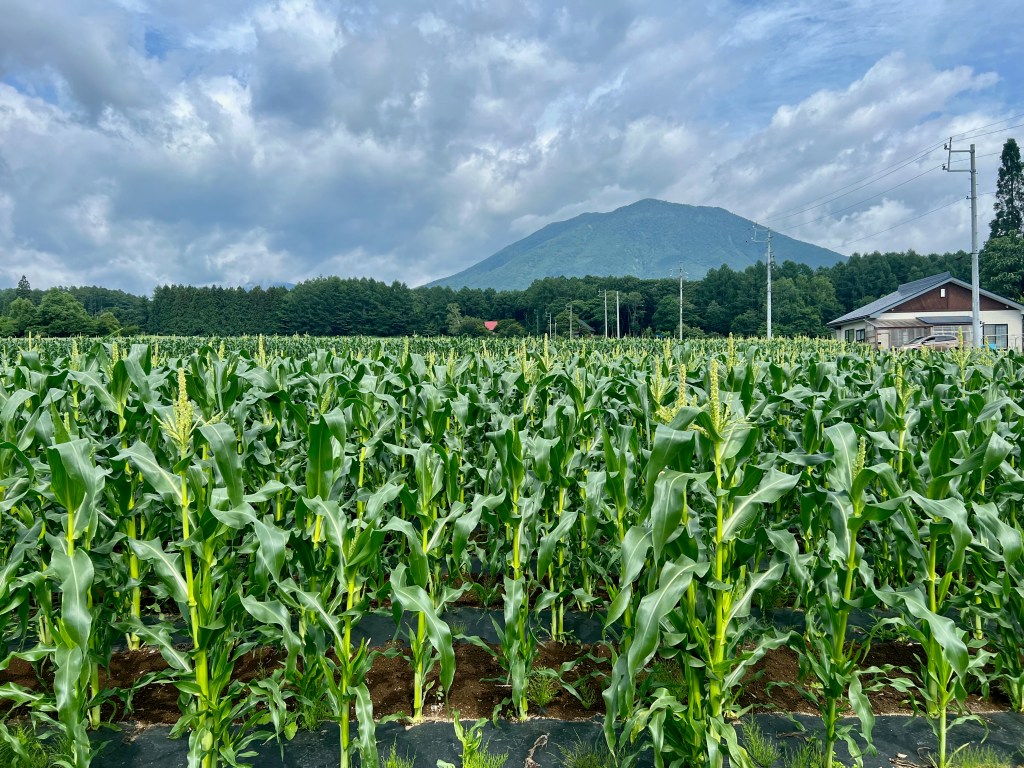
It may be surprising to some, but the main crop in our farming village of Tomigahara is not rice but corn! (Note: Tomigahara is an administrative sub-unit of Shinanomachi town in Nagano Prefecture). Our neighborhood farmers CANNOT grow rice here since the altitude is above 600 meters. Previously, the main crops were white radishes and buckwheat (the main ingredient in Japanese soba), but over the past decade more and corn has been planted and has become a major cash crop for the village since it does not have to be marketed through the local agricultural cooperative. Rice and a few other products are designated by the government as crops important to Japan’s self-sufficiency in food and production is carefully regulated and financed from seedling to table. This also impacts on the buying and selling of land designated for rice production.
These restrictions have posed serious obstacles to the growth and future of Japan’s wine industry. Vineyards have to be carved out at considerable expense on mountain sides where rice is not grown and operations at scale are constrained by challenges in acquiring the patchwork of small plots that are characteristic of Japan’s rice cultivation. Paradoxically, however, wine production is increasing in part due to climate change since rising temperatures have made higher altitudes more friendly to grape growing. In fact, many of the smaller, new wineries advertise the fact that they are operating in areas between 800 and 1000 meters.
The same can be said for corn. It really does well in our village. The corn is very sweet and the kernels are soft enough that they require little or no boiling before eating. In fact, one of the local outlets purees raw kernels from the cob and sells the result as a topping for ice cream. Local table grapes are equally delicious — now we need to work on the wine.
In that spirit, we went a little off the chart in the wines that we tasted this month. First, we checked out a Pinot Noir made by last year’s top Nagano winery, Votano. We were not disappointed, but rather amazed at experienced winemaker Tsubota’s challenge to the common wisdom that Pinot’s do not do well in the Nagano. The prefecture is caught between the Pacific Ocean and Sea of Japan and the weather throughout the growing season can cycle erratically from hot and humid to cold and wet. Second, we followed up on a pledge we made in our June 2023 blog to assay the future of the Petit Manseng grape in Nagano winemaking. The results are quite encouraging.

Votano Wine Pinot Noir 2021
Readers of this blog may recall our travails with locally produced Pinots. Somehow the harvest deadline and the ripening of the Pinot grape seem grotesquely out of line. This observation was confirmed by the frustrations of Obuse winemaker Akihiko Soga, who along with his brother, Takahiko, tried for years to come up with a Pinot Noir that was “drinkable” — not even great. The problem was ripeness and the scourge of unwanted “vegetative” flavors. Nearly a decade ago, Takahiko, gave up and moved to Hokkaido to open his own winery, Domaine Takahiko Nanatsu Mori, which now is producing arguably the best Pinots in Japan at 11,000 yen a bottle — but with production limited to 9000 bottles annually the street price can go as high as 27,000 yen. See our October 2021 blog.
So when our good friend, Mitsuhiko Tsubota, the owner and winemaker at Votano Wine (our winery of the year in 2022), came up with a Pinot, we were intrigued. The alcohol level of the wine is 13 percent, the color velvet and the nose offers up the promise of deep, red cherries. Mr. Tsubota’s wines in past years have been troubled by under ripe grapes and the odor of “green vegetables”. This is endemic among many of the smaller Nagano wineries due to the vagaries of the weather — but Mr. Tsubota appears to know how to manage this better now. The first sip from the bottle to glass had a hint of green peppers, but this resolved itself nicely when the wine was given a chance to breathe and warm up slightly. And what emerged was a refined and restrained taste of dark, red fruits (think currants and blackberries) which were neatly balanced by beautiful acidity. The wine was sweet without being jammy or murky. You want your Pinot to glow red in the glass! Equally important, the price is right. You can pay twice as much for a good Pinot from one of the major producers and not be as happy!
Price: 4000 yen; available directly from the winery.
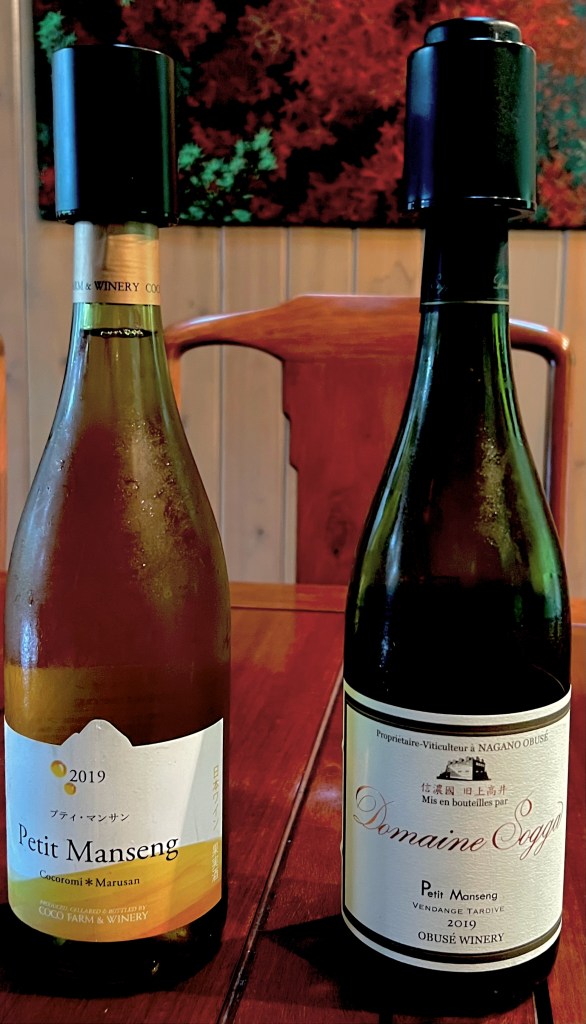
Two Petit Manseng: Coco Farm Winery 2019 and Domaine Sogga 2019
We returned from our visit in May to Washington, DC interested to see whether the Petit Manseng grape that we enjoyed at the Sugarloaf Winery in Maryland might also be produced in Japan. We found Coco Farm Winery, an interesting wine maker in Tochigi Prefecture (near Tokyo) that first planted the grape in 2006 and began making wine in 2016. The winery was established more than 50 years ago with a mission of providing training and support for physically and mentally handicapped young people. While the winery does use grapes from Nagano producers, the Petit Manseng fruit are exclusively grown at the Coco Farm vineyard in Tochigi.
The first impression from this wine is an intense sweetness that is unusual in a Japanese white wine — but one that is balanced by ample acidity which as the glass warms produces a balanced and highly drinkable wine to start or finish a meal. The nose is luscious and sweet and the color a sparkling gold that reinforces the rich taste of the wine. Alcohol is a modest 11 percent, but the dynamics of the wine revolve around its striking acidity and glowing sweetness. Due to the hot and wet weather throughout the summer, the white wines made in Japan (typically Chardonnay and Sauvignon Blanc) can be somewhat sour and listless. Petit Manseng thrives in these conditions and were it to be more widely available it could in our view provide some real competition to the 冷酒 (cold sake) that tops the menu during the hot months of July and August. Japanese love sweet alcoholic drinks with food and the Petit Manseng brings that along with a delightful taste of pineapple, honey and some leavening citrus flavors.
The price at over 4000 yen a bottle puts it at a disadvantage to the much cheaper sake — and our friends at Yorozuya tell us that the “petit” in Manseng references the small size of the grape, which is characteristic of this varietal and means that you need more grapes per bottle to produce an equivalent amount of wine. We do not quite understand the mathematics of this, but we can vouch for the potential of this wine to provide an alternative to sake, if it can be put on the menu of izakayas in Japan.
Price: 4,300 yen; available online from Amazon
Another contender in this space is the Obuse Winery that, while its overall production is small, makes a wide range of interesting red and white wines. Obuse Winery owner Mr. Soga in his always quite detailed description of the wine making process on the label of his wines is quite frank in indicating that he produced the Petit Manseng as an “experiment”. He notes that, while the grapes at harvest registered a 25 Brix level, the fermentation process for the wine actually was halted by exceptionally cold weather during the winter of 2020. But the wine still comes in at 13 percent alcohol and overall we find this to be an exceptional wine — sweet but smooth and acidic without being edgy. Not that everything is in place as the wine come out of the bottle. We found it took a day or two to settle after opening — but it was well worth the wait.
Comparing the Obuse wine with the Coco Farms Petit Manseng, which we found to be sweet and fresh, you might describe the Obuse version to be fragrant and mature. There is a smoothness on the tongue and a character and a depth to the wine that you don’t encounter often in Japan. This is not a cocktail wine, but rather something to enjoy with fine cheese or sip with cigars after dinner. It stands up to either with a voice of its own.
Price: 4,200 yen; available from these wine shops in Japan

 Friends of Nagano Wine