


Wines of Renegade Winery in Walthamstow, United Kingdom
Jim and Mariko (along with Keiko) were in London during July and into August to help out with (and celebrate) the birth of a new addition to our family. Daughter/sister, Komaki and her husband, Andy, birthed a beautiful baby girl named Juneau. The new family lives in the village of Walthamstow, which is part of Greater London, and just 30 minutes on the Victoria Line to Buckingham Palace.
Of course, wine was an important part of our celebrations and we were impressed by the variety, and price/performance of the wines available in the UK.
For Jim, the British were more the type to guzzle local ales on tap in the noisy pubs located on virtually every corner or sip Martinis or whiskies at high class cocktail venues, such as Duke’s Bar in St. James Place, where author Ian Fleming of James Bond famously directed that his Martini be “shaken not stirred”. (Jim concurs with this and visited Duke’s twice during his recent stay — as he has every time he has been in London over the past 30 years.)
The British have always enjoyed good wine, but from elsewhere. Now, local good wine is very much a part of the equation in the UK. One of Jim’s tasks during the visit was to to walk Komaki’s Australian Shepherd daily around the village and the beautiful neighboring nature reserve. The trip also took him by a craft beer and wine establishment, called Clapton’s Craft, which has a wonderful collection of Belgium beers and wines from France, Italy, Spain and Germany to drink. Not surprisingly, it became a daily ritual at the end of our evening walk for Jim and the dog (named Ruby) to stop by for a half hour or more at Clapton’s to chat with the owners and customers and for Ruby to have some water while Jim drank a pint.
This all bring us to the Renegade Winery and its mission to transform the wine scene in the UK. The issue is not with the availability of good wine in London — but the lack of good British made wines. The fundamental problem for the UK is that like in Japan the climate is not friendly to growing grapes for wine-making. In the UK case, the climate is too cold and wet during the summer (even this year!) to allow the grapes to ripen properly. The result is lower alcohol levels and wines that can be too tart or conversely listless and with weak flavorings. And, as in Japan, climate change is beginning to shift this equation (although in different ways). The Chardonnay grape, in particular, appears to have benefitted most and there is much speculation in Britain about how the UK might replace France as a leading producer of sparkling wines.
But, while climate change is “real” and a factor in wine production, betting that it will transform rural areas of Great Britain into “wine country” is a bit premature. Japan, the US, and Europe suffered under record high temperatures approaching and exceeding in some cases 40 degrees celsius, but the British weather that we experienced in London in the July and August period was comfortably cool with an average daytime temperature of 20 degrees and dipping down to 16 degrees in the evening — something perfect for sunset dining, but lousy for wine. So enter the concept of an “urban winery”.

Renegade Winery founder Warwick Smith, who launched the Renegade Winery in 2016, says that he was inspired by the success of “urban wineries” in Oregon and New York. Essentially, an “urban winery” is a winemaker that does not own or manage vineyards, but instead buys grapes from local and international producers, and produces wines in an urban setting close to its consumers and derives its revenues as much from restaurant traffic and party catering as it does from bottle sales.
Ever attentive to shifting tastes in wines (as well as market creation) among young people in London. Smith produces 20 to 30 different wines each year shifting his portfolio of vineyards annually and creating wines that break rules in terms of blending and ageing. Last year, Renegade Winery sold 68,000 bottles of wines. Smith thinks that he still has a long way to go to produce the kind of profitability and presence in the market that he is aiming for. While he now has a WSET 3 wine credential (4 or Diploma is the top). Smith got his start in the world of investment banking and worked for years in Singapore for a major British firm before returning home to the UK (presumably with some cash and the skills necessary to raise even more). The launch of the winery was not retirement but a mid-career move.
We will be reviewing a number of Renegade wines below. Some of them are quite good — all are drinkable. But first we want to table the question of what Japanese winemakers might learn from this “renegade” business model. We do not have precise production figures for the Big Four wine producers in Nagano (Suntory, Manns, Chateau Mercian and Sapporo) or for major independents like ALPS and Izutsu, but sales of 68,000 bottle would be very impressive for any wine producer in Nagano in the business for less than ten years. And Smith’s success in building a wine business could be a new model for the many young and old aspiring winemakers, who have followed their dreams to Nagano, buying property and equipment to make wine, growing grapes, and then marketing the bottles usually online — with most selling only a few thousand bottles each year, if that.
Let’s make a big statement: the wine market in Japan remains relatively small compared with Europe and the US — not necessarily because Japanese prefer local sake and other traditional beverages over wine, but because the price of wine is relatively high and supply is limited. The reason, as we have often pointed out, comes down to land use policy: it is expensive and difficult to convert agricultural land in Japan to other purposes than growing rice. Compounding the issue is the climate: summer in Japan is hot and humid and the October harvest is hostage to the fall rainy and typhoon seasons. Japanese wine growers and makers are very smart and persistent — and Japanese consumers are buying the wine that they make. But they cannot produce enough of it at a price that can build the market and get Japanese drinking more local wine rather than imports.
What struck Jim during his visit to London is that the UK market at one level is much like the Japanese market. Local wine is not widely available — and imported wines are good and priced to sell. And, in that context, Renegade Winery’s gambit to buy grapes from vineyards outside Great Britain and make his wine right in the middle of London, where his target market of young, next generation wine drinkers live, may be a stroke of genius.
But wouldn’t this portend the end of Nagano prefecture as a wine producer? Absolutely not! These apparently conflicting business models can be two sides of the same coin. That is, a winemaker can do both: grow grapes locally as well as import grapes from areas with good sea and air connections to Japan like Australia, New Zealand, South Africa and even the Western US (California, Oregon and Washington). Foreign grapes have not replaced the local product in Smith’s model. He has relationships with a number of local UK vineyards and purchases grapes from them to produce either stand alone or wines blended with outside grapes. The point is that Renegade is not a “vineyard” but a “winery”. That is a different business model and like in the UK this approach may be more congruent with the “terroir” (situation) in Japan. Food for thought — but what does the wine taste like?
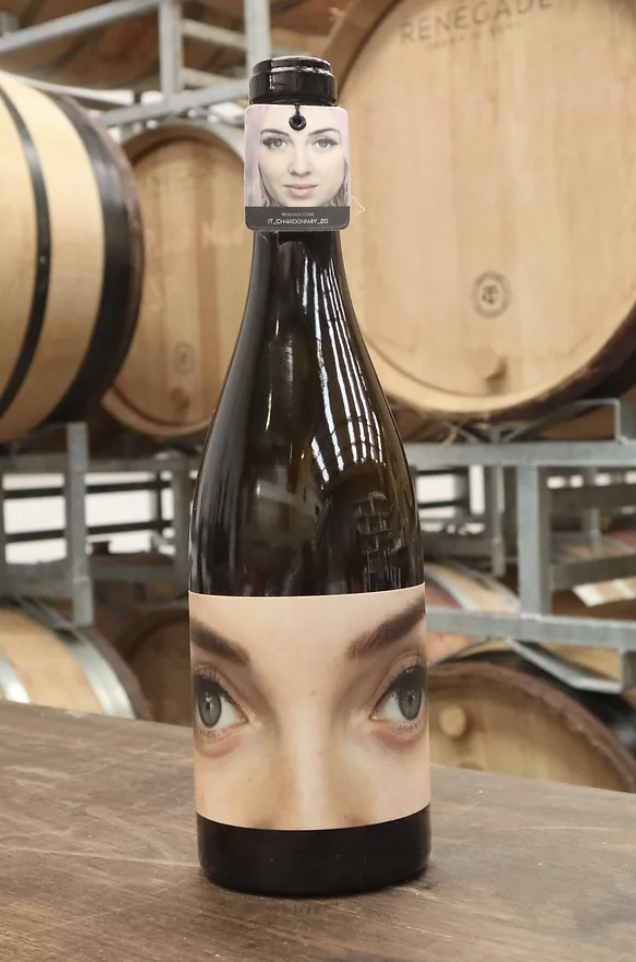
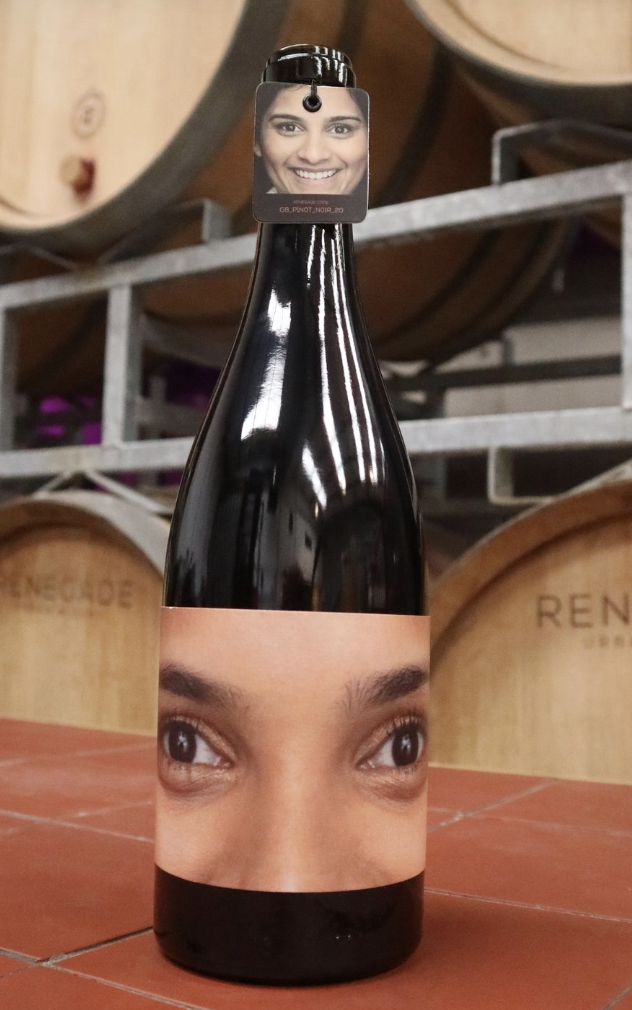
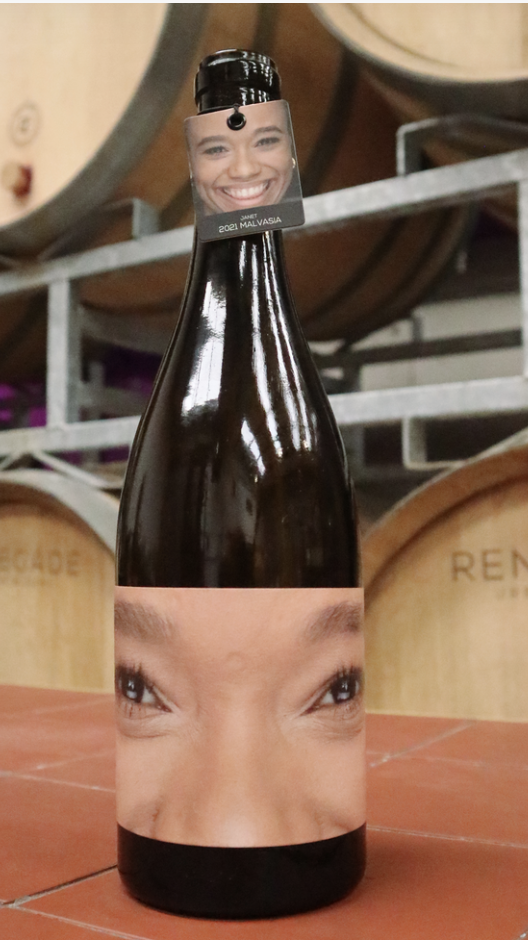
Below we give our thoughts on each of the four Renegade wines pictured above in the order in which they appear. To start off, we will first answer a likely “burning” question: who are those people on the bottles? Well, Smith obviously knows how to market a product. For many of the wines that he produces, there is a pre-release contest in the form of a lottery among Renegade wine club members to put a “face” on the bottle. We were not able track down “who” is Amy (Chardonnay 2020). But Shivam (Cabernet Sauvignon/Pinot Noir blend 2021) works in “public health and safety”; Janet (Malvasia 2021) is a “West End designer” and Varnika (Pinot Noir 2020) is a “medical student”. So they are real people (not models), who like Renegade wines.
And putting them on the label implies a conceptual shift in thinking and talking about wines. Rather than referencing a bottle by the grape and the year produced Renegade speaks about its production in terms of Amy’s bottle or Shivam’s wine. This can be confusing but it is also refreshing — and underlines Renegade’s willingness to challenge how wine is made and marketed. For Smith (it seems) the true measure of a wine seems to be not necessarily how “good” it might be from the perspective of a wine expert– but how the younger generation of wine drinkers in the UK react to it.
“Amy” 2020 Barrel-Fermented Chardonnay
This is a beautiful wine made in oak barrels, which impart to the wine pleasing aromas of vanilla and spices that commingle nicely with the ample fruit flavors of peach and nectarines. It is the perfect summer wine. The Chardonnay grapes are from a contracted vineyard in Lombardi, Italy. Alcohol levels are a pleasing 13 percent alcohol and there is an absence of the unripe “sourness” connected with rainy and cool weather in the run up to harvest, which troubles both British and Japanese Chardonnays. The price at the winery is 28 pounds (5000 yen at current exchange rates) — a bit expensive but this is downtown London and the wine is already sold out on the website.
“Shivam” 2021 Cabernet Sauvignon Pinot Noir Blend
This is “two-country wine”, with the Cabernet Sauvignon grapes coming from Spain and the Pinot Noir from Germany. So you have the bright sun and warmth of Spain blended with the cooler, more restrained climate of Germany (which is the third largest producer of Pinot Noir globally). The resulting wine has the flavors of strawberries, raspberries and rhubarb and a just right 13 percent alcohol level. The price at the winery is 26 pounds (about 4700 yen at current exchange rates). This is an unusual blend — in part because the character of these wines are so different. Cabs are all about tannins and strong flavors; Pinots are delicate, sweet and fruity. We did not have a chance to ask Smith why he took this path, but it seems to fit into his philosophy of “taking the road less travelled”. We liked this wine a lot: think beautiful fruits, nice structure and a solid finish. ,
“Janet” 2021 Malvasia
The Malvasia is a white grape that produces a golden colored wine with the taste of nuts and honey. Malvasia grapes are a popular Mediterranean island grape and Renegade gets its supply from Puglia, Italy. The move is clearly targeting a younger demographic who may want to move a bit beyond traditional white wines like Chardonnay and Sauvignon Blanc for new and different flavors. This fits the bill and its 13 percent alcohol keeps it fresh and interesting. We were really captivated by this wine and believe that it’s sweet (yet light and crisp) flavor could be popular as well in Japan. We found one very small producer who makes it in Yamagata prefecture — but it is not really on the radar elsewhere here. Renegade sells its version for 27 pounds (around 4800 yen at current exchange rates).
“Varnika” 2020 Pinot Noir
This is one of the few wines on the Renegade wine list that is made from grapes grown in Britain in Suffolk County, an area about 90 miles from London. We wanted to try a “British” wine and this came recommended by the Renegade staff. Not surprisingly perhaps, it reminded us of the issues that Japanese winemakers struggle with in trying to produce a Pinot Noir that measures up to those from Continental Europe and the US. This wine is light bodied and has the requisite flavors of cranberries, cherries and rosemary. It is also aged in oak, which gives a kind of smooth sweetness to the wine. Alcohol levels were 12 percent — reflecting how hard it is to achieve sugar levels in Britain’s cool summer climate. And the price at 28 pounds (about 5000 yen) is expensive for a wine that is sadly not as good as Japanese Pinots in this price range. It is an example of why Renegade’s Warwick Smith has generally looked abroad for grapes to bring to London for winemaking.

 Friends of Nagano Wine